Silent Speech Interfaces: Why RF Beat the Electrodes
Silent speech interfaces decode mouthed words from muscle and RF signals. Why the sensor tradeoffs and signal-to-noise problem make them unlike dictation.
 James Whitfield

You're in the library, dictation app running, and you've just mouthed the same email four times into your laptop like a lunatic because speaking out loud would earn you a stare from the entire floor. Silent speech interfaces exist precisely for this moment — systems that decode the words you mouth, or even just intend to mouth, without a single audible sound leaving your body. A new crop of startups is betting that the missing input device for the AI era isn't a better microphone. It's no microphone at all.
The idea is older than the current wave of demos suggests. NASA researchers were experimenting with subvocal recognition in the mid-2000s, originally for astronauts and flight crews working in noisy or pressure-suited environments. MIT's Media Lab made it famous with AlterEgo in 2018, a wearable headset that captured neuromuscular signals from the jaw and face. What's changed recently isn't the concept — it's that cheap radio hardware, better machine learning, and the sudden mainstreaming of voice AI have converged to make the engineering almost tractable. Almost. The signal-to-noise problem here is genuinely brutal, and the way teams solve it determines everything about the product they end up shipping.
Speaking Without Sound: What Subvocalization Actually Is
There's a useful bit of terminology worth getting right, because the field conflates three different things. First, there's mouthing: full articulation with lips, tongue, and jaw, just with no voice. Second, there's internal speech — lips closed, but the tongue and soft palate still move deliberately as if forming words. Third, there's true subvocalization, the faint, involuntary muscle activation that happens when you read or think in words. That last one is the sci-fi version, and it's barely detectable outside a lab. Working products today live in the first two categories. One team building RF-sensing glasses describes their target behavior as "mouthing with your lips closed" — a weird hybrid that users apparently learn within a few sessions.
As a language nerd, I find the linguistics here delightful. Articulation is a motor program your brain runs regardless of whether the vocal folds vibrate. Voicing is just one stage of speech production — the part where the larynx adds acoustic energy. Strip it away and the entire upstream choreography remains: tongue position for vowels, lip rounding, velum control for nasals. A silent speech interface is essentially trying to reconstruct the phoneme sequence from the residue of that choreography, like deducing a melody from watching a pianist's fingers on a muted piano. It's lip reading from the inside.
This framing matters because it tells you what the sensors must measure. Nobody is reading your mind. Every successful system taps into some physical correlate of articulation — electrical impulses, tissue motion, or reflected energy — and the choice of which correlate to chase is the defining engineering decision.
EMG: The Obvious Sensor That Betrays You
Electromyography is where almost everyone starts, because the logic is irresistible. Muscles fire because motor neurons dump electrical potentials across membranes; stick an electrode on the skin over the right muscle and you can watch it happen. Surface EMG is a mature technique — prosthetic limbs have been steered by residual muscle signals for decades. For a weekend hackathon, you can literally tape electrodes to your face, wire them into an amplifier, and get something that flickers in rough correspondence with mouthed letters. Multiple silent speech prototypes have been built exactly this way, including the now-famous MIT AlterEgo and, reportedly, the first crude attempt by the team now shipping RF glasses.
Then reality intervenes, in a depressingly predictable list of failure modes:
- Sweat. Skin conductivity drifts as you perspire, so the same mouthed word looks different at 9 a.m. and after lunch. Your calibration is decaying continuously under you.
- Electrical interference. Facial EMG signals are in the microvolt range. Nearby power lines, your laptop's switching supply, even blinking can swamp them.
- Placement variability. A two-millimeter shift in electrode position changes which muscle fibers dominate the reading. Take the device off and put it back on, and yesterday's model is measuring a slightly different person.
- The cosmetic dealbreaker. Nobody will wear gel electrodes on their face in public. This sounds trivial; it killed the approach anyway.
That last point deserves respect. Consumer hardware fails on friction far more often than on physics. The history of wearables is a graveyard of devices that worked in the lab and demanded one step too many from the user. Bone-conduction headsets, chest-strap heart monitors, EEG headbands — all technically sound, all niche. When your sensor requires daily skin prep, you've built a medical device, not an input peripheral.
RF Sensing: Reading the Mouth From the Inside
The approach that's gaining traction now replaces electrodes with radio. The idea: antennas embedded in eyeglass frames emit low-power radio waves, at Bluetooth-adjacent frequencies, that pass through your face. As the waves cross moving tissue — tongue, lips, soft palate — they're modulated in tiny, structured ways. Receive antennas pick up the perturbed signal, and a neural network learns to map those perturbations back to text. It's the same family of physics as Wi-Fi-based gesture sensing and the radar Google put in the Pixel 4 for hand gestures, pointed at a much subtler target.
The appeal is that RF sees what cameras and skin electrodes can't. The tongue is invisible from outside once your lips are closed, but it's a big, water-rich muscle that radio waves interact with strongly. Lips-closed internal speech — the discreet mode people actually want in a meeting — is only reachable through a through-tissue modality like this. That's the entire product argument in one sentence: EMG and cameras capture the outside of articulation, RF captures the inside.
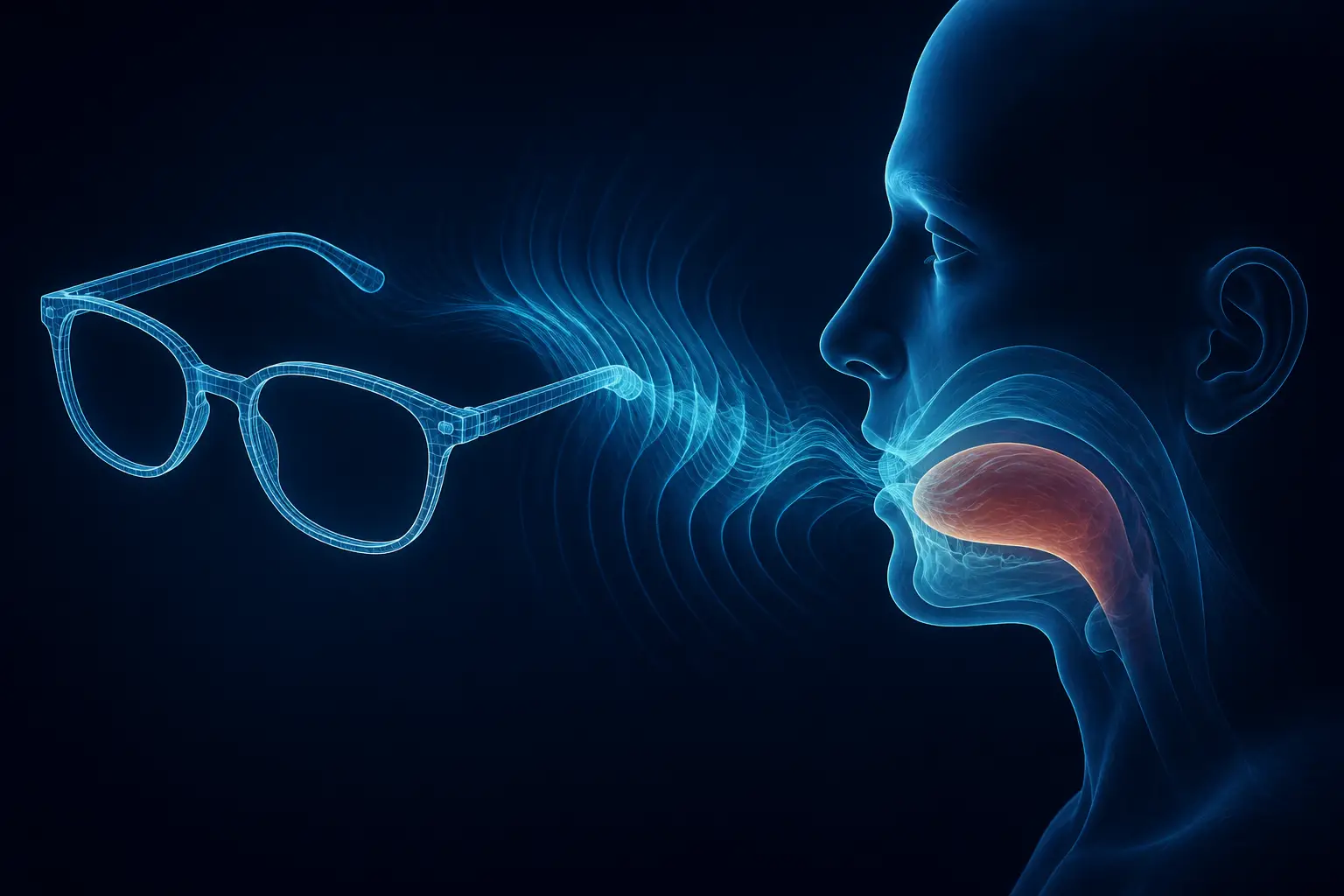
The engineering to get there is not gentle. The signal you're after is a faint modulation riding on a carrier, so the entire RF front end has to be extraordinarily low-noise. Antenna placement is an optimization problem with teeth: the electromagnetic fields must overlap maximally with the articulators, which means simulation-heavy frame design where millimeters of antenna position change what the system can hear. The team building the current glasses prototype admits their first glasses-integrated attempt failed completely, and they regressed to taping antennas to their faces, then to a rigid head rig to hold geometry constant, before simulation work got the frames right. That progression — tape, rig, product — is the honest archaeology of hardware that actually ships.
Cameras and Ultrasound: The Also-Rans With Real Niches
The camera path — visual lip reading — has the deepest research pedigree. LipNet demonstrated end-to-end sentence-level lip reading from video years ago, and open-source projects keep replicating the trick with a webcam and a face tracker. It's the cheapest sensor imaginable: you already own three cameras. But it inherits the brutal constraint that it only sees the outside of your face. Closed-mouth internal speech is invisible by definition, lighting and head angle corrupt the input constantly, and pointing a camera at your own face all day has privacy and battery costs that never go away. Lip reading remains excellent as an augmentation to audio speech recognition — the audiovisual models genuinely outperform audio-only ones in noise — but as a standalone silent interface it's capped at the "obviously mouthing" end of the spectrum.
Ultrasound occupies a stranger middle ground. Academic systems have pointed ultrasonic transducers at the jaw and reconstructed tongue motion from echoes, and tongue-ultrasound imaging is literally a standard tool in phonetics research — it's how we've watched vowels being made for decades. The sensing is good. The form factor is not. Nobody has figured out how to package a chin-coupled ultrasound probe into something you'd wear to a standup meeting, and acoustic coupling through air is lossy and angle-sensitive. My read: ultrasound is the right answer for clinical speech therapy and phonetics labs, and the wrong answer for consumer input.
If you're keeping score, the tradeoff table looks roughly like this:
- EMG: direct muscle signal, good bandwidth — ruined by sweat, drift, placement, and the need to wear electrodes on your face.
- Camera lip reading: zero hardware cost, mature models — blind to closed-mouth speech, fragile to lighting, privacy-hostile.
- Ultrasound: images the tongue directly — coupling and form factor make it a lab instrument.
- RF through-face sensing: sees internal articulators through skin, embeds in glasses — demands an exotic low-noise RF stack and mountains of training data.
The Signal-to-Noise Problem Is Not the Dictation Problem
Here's the conceptual mistake most of us make when we first hear about these devices: we assume it's speech recognition minus the air. It isn't. Audio dictation rides on a signal nature engineered for communication — tens of decibels of clean pressure wave, shaped by evolution to carry phonemes across a room. The hard parts of ASR are accents, vocabulary, and noise rejection. The signal itself is generous.
Silent speech sensing has the opposite profile. The carrier — whether microvolts of EMG or a faint RF modulation — was never meant to encode language. Phoneme information is smeared across sensor channels with no clean mapping, and the confounds are physiological, not acoustic. Swallow, clench your jaw, turn your head, touch your face: each injects a transient that can dwarf the articulation signal. Where an ASR system fights a noisy room, a silent speech system fights your own body. You are the noise floor.
Two consequences follow. First, these systems lean far harder on language modeling than dictation does. When the sensor evidence for a phoneme is ambiguous, the decoder resolves it with priors about what you probably meant to say — the same trick that makes constrained decoding so effective at turning fuzzy model outputs into reliable decisions. Expect silent speech systems to be eerily good on predictable text (commands, emails in your own register) and noticeably worse on rare words, names, and code identifiers, where the prior can't rescue a weak signal. Second, calibration is structural, not incidental. Audio ASR generalized across speakers decades ago because a waveform is a waveform. A facial RF signature is not — which brings us to the hardest problem in the field.
Every Face Is a Different Antenna Problem
Cross-user generalization is where silent speech prototypes go to die. Facial anatomy — jaw length, tongue size, tissue density, skin thickness — varies enormously, and every one of those variables reshapes the signal. A model trained on my face can be nearly useless on yours. The early EMG literature is littered with systems reporting excellent accuracy "per subject, after calibration," a qualifier that quietly buries the product. A device that needs an hour of per-user training before it works is a research demo, not a peripheral.
What I find genuinely interesting about the current RF effort is that they tried the clever path first — algorithmic domain adaptation, signal normalization tricks — and concluded the only lever that works is brute pretraining scale. So they built recording booths in their office, paid people to read prompts while wearing the glasses, and watched error rates fall along a clean scaling curve as the dataset grew. The reported result: a new user needs only about twenty calibration sentences before the system works well. That number matters more than any accuracy figure. Twenty sentences is a tolerable onboarding flow; an hour of readings is a return request.

This is the same lesson the rest of machine learning keeps reteaching us: when a model fails to generalize, the answer is usually more diverse data, not a cleverer architecture. We've watched it play out in speech recognition, in machine translation for low-resource languages, and in every domain where the input distribution shifts per user. Silent speech just has a particularly vicious per-user shift, because the "microphone" is partially made of the user.
Where Silent Speech Actually Wins
Strip away the novelty and the use cases sort into a clear hierarchy. At the top: accessibility. There's a commenter demographic — developers with repetitive strain injuries facing double carpal tunnel surgery, people returning to open offices where dictation is socially impossible — for whom this isn't a gadget, it's the difference between working and not working. Laryngectomy patients and people with ALS-adjacent speech loss are the deeper, more important version of the same story. Any honest evaluation of this technology should weight that heavily.
Second: loud environments, which is the counterintuitive one. A sensing modality that ignores acoustics entirely doesn't care about your lawnmower, your server room, or your factory floor. Voice fails precisely where RF sensing is indifferent. Third: discretion — dictating in libraries, open offices, trains. This is the mainstream consumer pitch, and it's real, but I'll note it's the weakest of the three because it's a social comfort feature rather than a capability unlock.
My position on the trade-offs: this technology earns its form factor only if inference is on-device or at least offline-capable. A sensor that watches your tongue move inside your closed mouth, streaming raw data to a cloud API, is a privacy architecture nobody should accept — the commenters worried about involuntary-signal leakage have a legitimate grievance, even if some of the more speculative fears are overblown. The good news is that the decoding models are small enough to run locally; the field would do well to treat offline-first design as table stakes rather than a premium tier. Wake-word equivalents matter too — the glasses need a deliberate, physical intent signal (a gesture, a jaw clench pattern) before they listen, or you've built a wearable that transcribes your every involuntary mouth movement.
There's an older echo here I can't resist. Telegraph operators in the 1870s learned to read messages by the sound of the relay clicking, an input channel nobody designed. The history of interfaces is full of these side channels becoming first-class channels once someone builds the decoder. Subvocal muscle chatter is a side channel of reading and thought that humans have leaked for as long as we've had inner monologues. Turning it into an input device is less an invention than a promotion — and if the scaling curves hold, the quietest person in the library may soon be the one getting the most typing done.