Local-First Home Automation: Surviving WAN Outages
Local-first home automation keeps lights, locks, and heating working when the internet dies. Learn on-device control loops and graceful degradation.
 James Whitfield
A few winters ago I watched a friend stand in his own hallway, phone in hand, unable to turn on the lights because his ISP was having a bad evening. The bulbs were fine. The switches were fine. The round trip to a data center two thousand miles away was not. That scene captures everything wrong with how we've been building smart homes, and it's why local-first home automation isn't a hobbyist affectation anymore — it's the only architecture that respects what a house actually is: a system that has to keep running when everything upstream of it fails.
The WAN Is a Single Point of Failure You Invited In
Engineers who would never design a datacenter with a single point of failure happily install light bulbs that stop working when a vendor's API changes. Think about that. We understand redundancy, failover, and blast radius in our professional lives, then go home and wire our front door locks to someone else's uptime SLO.
The failure modes aren't hypothetical, and they're not limited to your own internet connection dropping. The taxonomy is richer and bleaker than that:
- Vendor API churn. Google deprecated the Works With Nest API and broke thousands of working integrations overnight. The hardware in people's homes didn't change at all — the permission to use it did.
- Company death. A Bluetooth meat thermometer that only worked through its maker's app became e-waste the day the company folded. The hardware outlived the business model.
- Cloud shutdowns. D-Link killed its Home cloud service and orphaned every sensor bound to it. Owners of a $30 water leak detector suddenly owned a $30 plastic puck.
- Local functions held hostage. There are TVs that refuse to switch HDMI inputs without a WAN connection, fridges that show TLS certificate errors on their own door displays, and grill controllers that need Wi-Fi to report a temperature from a probe sitting two feet away.
- Plain outages. DNS hiccups, ISP maintenance, a backhoe in the wrong field. Boring, frequent, and entirely outside your control.
Every one of these is the same underlying design error: a control loop that spans the internet for no engineering reason. A thermostat measuring the air in your living room and actuating a furnace in your basement has no business routing that decision through Virginia. We've seen this movie in industrial settings, too — when attackers went after supermarket refrigeration, the lesson was identical: systems that control physical things must be designed around the assumption that the network is hostile or absent.
Failed Attempts: The Grudging Workarounds We Tried First
The industry and the community have tried several escapes from this trap, and most of them treat the symptom rather than the architecture. It's worth walking through why they fail, because the failure shapes what actually works.
Smart Bulbs and the Tape-on-the-Switch Anti-Pattern
The most common first move is buying smart bulbs. It ends with someone taping the wall switch in the ON position so the bulb keeps power, and now a switch that worked for fifty years does nothing. You've added a new way to control the light while removing the old way, which is backwards. The first rule of retrofitting anything — houses, codebases, airports — is that the old path keeps working while the new one earns trust. In-wall smart switches cost more effort to install but preserve the muscle memory of every guest who walks into the room. The bulb was the lazy purchase; the taped switch is the interest payment.
VLANs: Quarantine Is Not Independence
The next move is the IoT VLAN: shove every sketchy device onto an isolated network so it can't spy on your laptops. I do this too, but let's be honest about what it is — containment, not resilience. A VLAN stops a camera from exfiltrating your data to the internet; it does nothing when the camera needs the internet to hand you its own video stream. You've made the device safer and exactly as fragile. Security isolation and availability are orthogonal problems, and conflating them leaves your house dark in an outage just the same.
Vendor Promises and Checklist Buying
Some people try to solve it at purchase time by trusting marketing: "works with X," "local control supported." The problem is that these claims are unverifiable until the day they're false, and the vendor can change them retroactively with a firmware update. A device whose offline behavior you can't audit is a device whose offline behavior you don't have. This is the same trust problem we've learned the hard way elsewhere in the stack — the gap between what a spec promises and what an implementation does is exactly where the bugs live.
What Actually Works: The Local-First Control Loop
After ten years of running my own house on these principles, the working architecture is boring in the best way. Every safety-relevant or comfort-relevant control loop closes on hardware I own, inside my walls. The internet is allowed to add conveniences — voice control, remote dashboards, notifications — but it's never in the critical path of the loop itself. One practitioner framed the rule perfectly: nothing core in the house depends on a vendor's server, full stop. Alexa is just another way to flip a switch, never the only way.
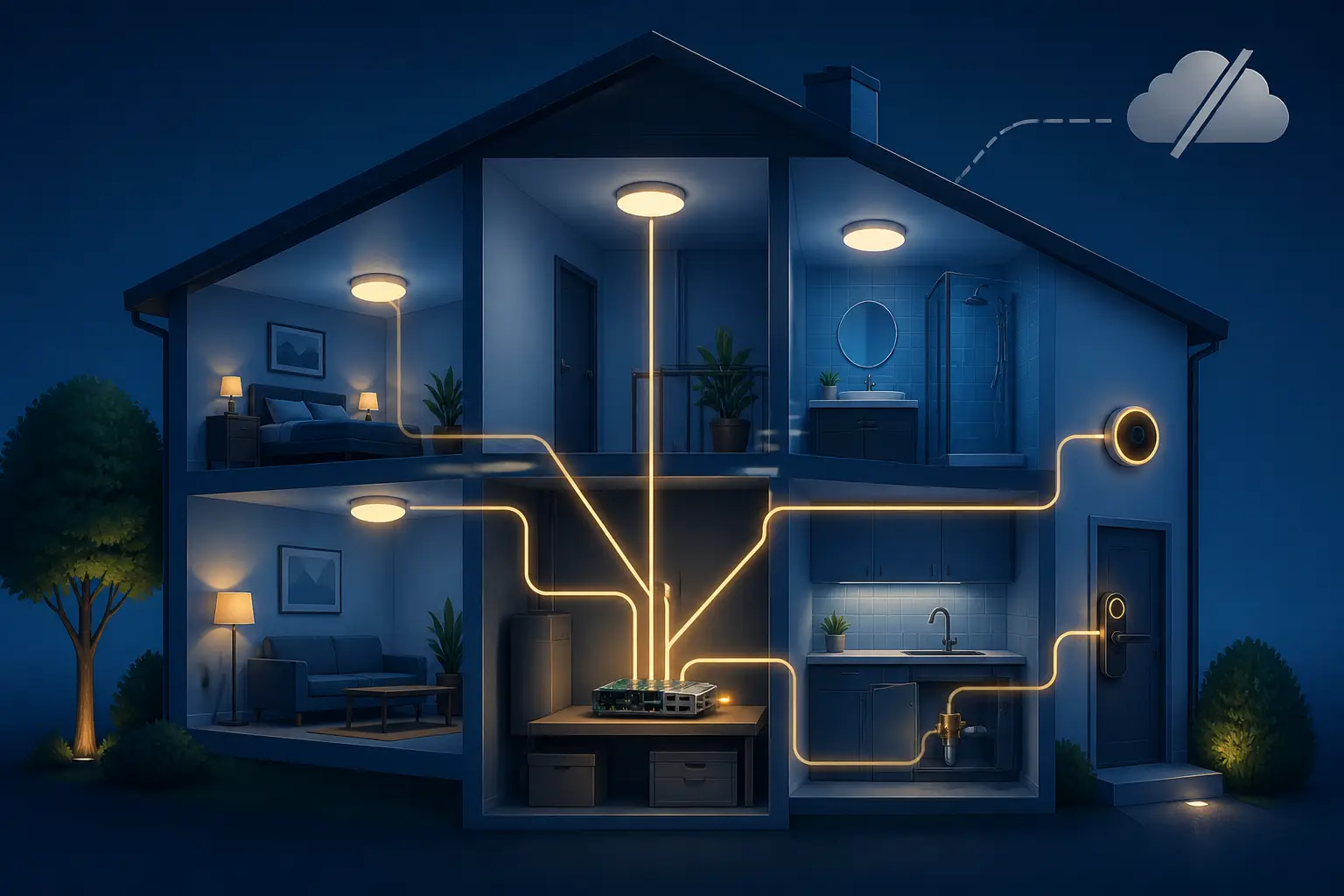
Concretely, the stack looks like this in a lot of serious home setups, mine included:
- Devices speak local protocols. Zigbee, Z-Wave, Thread, or Wi-Fi devices flashed with open firmware like Tasmota or ESPHome. If a device can only talk to its maker's cloud, it doesn't get installed.
- A broker decouples everything. An MQTT broker on a small always-on machine (a Raspberry Pi 4 handles this without breaking a sweat) means a temperature sensor publishes its reading and doesn't care who listens. Dashboard, automation engine, and logger all subscribe independently.
- One automation engine holds the logic. Home Assistant or Node-RED, running locally. Not five vendor apps with five accounts — one place where the rules live and where you can read them.
- Cloud services bolt on at the edges. Voice assistants, push notifications, remote access. Each is an additional input or output, never a dependency of the core loop.
The publish/subscribe decision deserves emphasis, because it's the piece that makes the system grow without rotting. Point-to-point integrations are the singleton spaghetti of home automation: every new device multiplies connections to everything else. With a broker, a garage door sensor publishes home/garage/door/state and the world subscribes — the dashboard displays it, an automation reacts to it, Grafana logs it, a Telegram notifier pings you. The sensor never learns that any of them exist. That decoupling is what keeps a ten-year-old system cheap to change when rooms get repurposed and people move in and out.
A Concrete Loop: The Garage That Cools Itself
Abstract rules are cheap, so here's a real control loop that has survived for years — the garage cooling automation that shows up in nearly every talk given on this subject. The problem: a garage bakes in summer, and you want airflow without leaving the door open all day.
The flow, in Node-RED, is a handful of nodes:
// Simplified Node-RED function node: garage cooling decision
// Inputs arrive as MQTT messages on home/garage/#
const doorClosed = global.get('garageDoorClosed');   // set by reed + door sensors
const coolingRunning = global.get('garageCoolingRunning');
const insideTemp = msg.payload.temp;
if (coolingRunning) {
// Already running: just note it, don't stack actions
node.send([null, { payload: 'Garage cooling already active' }]);
return null;
}
if (!doorClosed) {
// Door already open: run the fan only
return [{ payload: 'ON', topic: 'cmnd/garage-fan/POWER' }, null];
}
if (insideTemp > 30) {
// Open the door, wait, then fan — the sequencer node handles timing
global.set('garageCoolingRunning', true);
return [{ payload: 'OPEN', topic: 'cmnd/garage-door/POWER' }, null];
}
return null;
Everything in that loop is local. The reed switch and door sensor publish over MQTT to the broker on the Pi. The fan is a Tasmota-flashed relay subscribing to cmnd/garage-fan/POWER. The decision node runs on the same machine. If the WAN dies mid-afternoon, the garage still cools itself, the state flag still updates, Grafana still logs. The only thing that breaks is the Telegram notification — which is precisely the correct blast radius. Notifications are a luxury; the fan is the function.
Contrast this with the cloud-native version of the same product: the sensor POSTs to the vendor, the vendor's rule engine decides, the command comes back down. Three WAN round trips inserted into a decision that involves hardware separated by fifteen feet. Each hop is a failure you didn't need to accept.
Protocol Choices: Zigbee, Z-Wave, Thread, Matter
The radio protocol under your devices determines who owns the conversation. My position, after watching a decade of ecosystems rise and collapse: buy Zigbee or Z-Wave for anything commercial, treat Wi-Fi devices as acceptable only when the firmware is open or replaceable, and watch Thread and Matter with cautious optimism.
Zigbee and Z-Wave both form local mesh networks coordinated by a controller you own — a $30 USB stick on your hub. Pairing, routing, and command delivery happen entirely on your premises. A Zigbee button talking to a Zigbee bulb through your coordinator works in a Faraday cage. The protocols are old enough to be boring, and boring is a compliment for infrastructure.
Wi-Fi devices are the tempting trap: cheap, everywhere, no extra hub. But a Wi-Fi device is just a tiny computer with an opinion about which server to call. Unless you can flash it — Tasmota and ESPHome cover a huge swath of ESP8266/ESP32-based hardware — you're renting its behavior from the manufacturer. The community has gotten startlingly efficient at this; people now buy the cheapest acceptable hardware, look up or generate a local-first firmware path, and end up with a fully local house for a fraction of the price of premium gear. When you buy for hackability instead of features, negative software reviews become irrelevant because you're replacing the software.
Matter over Thread is the first vendor-backed standard that's actually architected correctly: local control is in the spec, not the marketing. Devices commission onto your Thread mesh and accept commands from any authorized controller on the LAN — no cloud in the loop by design. I'm not ready to declare victory, because the specification-versus-implementation gap has burned us before and early Matter gear has had its share of pairing weirdness, but the direction is right. It's the first time the industry has standardized the thing the community built by hand. There's a useful parallel in how IRCv3 evolved a legacy protocol without breaking it: standards work when they codify what practitioners already proved.
Graceful Degradation: Define Your Failure Modes Before They Define You
The deepest principle in all of this isn't "no cloud" — it's deliberate degradation. Every system fails; the design question is what it fails into. An old smart TV whose apps are dead but which still works as a dumb HDMI panel is a well-designed device. A TV that won't switch inputs without phoning home is a bad one, even if it never actually loses connectivity. Same hardware class, opposite failure posture.
So before automating anything, decide what must work in degraded mode. My list, which matches what most long-time practitioners converge on:
- Switching. Anything with a wall control must respond to the wall control, always, full stop. Lights, fans, fireplaces.
- Temperature and safety. Heating, cooling, leak shutoffs, smoke and CO detection. These degrade toward safe defaults, not toward off.
- Access. Locks must open for the people who live here without an app, an account, or a network. Keypad, keycard, physical key — multiple ways in, no server involved.
- Guest-usable functions. If a visitor needs to use it — bathroom lights, the kettle plug — it must not require learning anything.
Everything outside that list is allowed to fail when the internet does. Voice control, energy dashboards, the coffee bar color picker — luxuries, and fine as luxuries. The discipline is knowing which column each function sits in before the outage, because during the outage is when you discover you never decided.
This mindset has a long pedigree outside the smart home. It's how aviation works: the fly-by-wire computers are layered over hydraulics that are layered over cables, and each layer assumes the fancier one above it might not be there. It's how we think about defensive engineering in systems that resist catastrophe — you don't prevent every failure, you arrange the failures so the safe layer is always underneath. And it's how mobile developers learned to build for spotty connectivity: core action works offline or from cache, extras wait for a connection. The house is just the newest place we've had to relearn it, and the same philosophy drives offline-first AI architectures for exactly the same reason: dependence on a remote service is a design decision, and you can decide otherwise.
The Human Rules: What Ten Years of Ownership Teaches
The protocol and firmware choices are the easy part. What actually breaks a smart home over a decade is social and procedural, and the rule set that emerges from long ownership looks less like a network diagram and more like a constitution. The ones that have earned their place:
- Never remove the old way while adding the new one. The most-broken rule in the genre, and the one with the most regret attached. The smart bulb behind a taped-on switch is the canonical violation.
- Check your automations against each other. One gardener's tale: four separate scheduled triggers all firing the same pump, discovered only by accident. Automations compose silently; audit them like code review.
- Exceptions must be exceptional. Break a rule only for a reason you'd still endorse in six months. "I was in a hurry" doesn't count.
- No black boxes. A cloud-dependent device needs an API with logs or it doesn't get installed. If you can't observe it, you can't own it.
- Multiple ways in. App, voice, wall tablet, NFC tag, QR code, physical switch. Different humans, different moments, different interfaces over the same local core.
- No batteries that die young. If a sensor can't go a year between changes, it'll be dead at 2am exactly when you need it.
- Repeated manual steps become routines. If you do something three times, automate it — but automate it locally.
There's a historical resonance here that I can't resist pointing out. A century ago, electrification spread through houses on exactly this model: the power came from outside, but the switching, the fusing, and the control all lived inside the walls, standardized and locally operable. Nobody designed a light that required the power company's permission to illuminate. The smart home era briefly forgot this and built devices that treat the house as a thin client. Local-first is just the restoration of the older, proven settlement — with better radios.
The hardware outlived the company, and it stopped working anyway. That's the failure every local-first rule is written against.
If you take one thing from this: the next time you're about to buy a connected device, don't ask what it can do. Ask what it still does on the worst day — ISP down, vendor gone, app delisted, account locked. Buy the things whose answer is "almost everything," flash the things that can be rescued, and leave the rest on the shelf. A house that keeps working when the internet dies isn't a nostalgic throwback. It's just engineering, applied to the place you actually live.